Strip the automation software off an autonomous forklift, and you're left with a steel frame, hydraulic lifts, and wheels. The sensors are the part that actually makes the truck drive itself. Get the sensor suite right, and a retrofit counterbalance forklift navigates narrow aisles, avoids pedestrians, and docks onto pallets with centimeter-level accuracy. Get it wrong, and you're dealing with false-stops every forty feet, missed pallet pockets, and a maintenance team that starts pulling sensors off the mast after the first week.
This article breaks down every sensor type that goes into an autonomous forklift—not as a marketing overview, but from the perspective of someone who has to spec, mount, wire, and tune them on a real truck in a real warehouse.
The 4 Sensor Categories Every Forklift Needs
Every autonomous forklift sensor falls into one of four functional buckets. Some sensors serve two categories (for example, LiDAR handles both navigation and obstacle detection), but understanding which bucket you're filling makes the selection process less chaotic.
1. Navigation Sensors
These tell the forklift where it is on the facility map.
- 2D LiDAR — The most common navigation sensor. A single scanning plane (usually horizontal) builds a 2D occupancy map for SLAM-based localization. Most AGV forklifts run at least one 2D LiDAR mounted 1.5–2.5 m above ground level for this purpose.
- IMU (Inertial Measurement Unit) — A 6-axis sensor (3-axis accelerometer + 3-axis gyroscope) that tracks the forklift's angular velocity and linear acceleration. An IMU alone can't localize, but it fills in position estimates during the 50–200 ms gaps between LiDAR scans and corrects drift when the truck decelerates or turns sharply.
- Wheel Encoders — Optical or magnetic encoders on the drive and steer wheels measure distance traveled and steering angle. They're cheap and reliable, but they drift on slippery floors and can't correct for wheel slippage on their own.
When these three inputs feed a localization algorithm (usually an Extended Kalman Filter or particle filter), the forklift maintains position accuracy within ±2–5 cm across a 50,000 sq ft facility. Drop any one of them, and accuracy degrades fast—particularly in long, featureless corridors where 2D LiDAR sees nothing but flat walls on both sides.
2. Perception Sensors
These tell the forklift what's around it and what's ahead.
- 3D LiDAR — Unlike a 2D scanner, a 3D LiDAR captures vertical geometry. It detects pallet overhangs, low-hanging sprinkler pipes, raised dock plates, and the fork tips themselves. A vertical field of view (FOV) of 70° or more covers the ground plane up to the top of standard racking.
- 3D Depth Cameras — Stereo or structured-light cameras that output depth maps at 30–60 fps. Excellent for pallet recognition (distinguishing a pallet from a stack of boxes) and for reading QR codes or AprilTags on rack locations. They struggle in direct sunlight and with dark or reflective surfaces.
- Time-of-Flight (ToF) Sensors — Compact solid-state devices that measure distance by emitting infrared light pulses. Range is typically 0.1–10 m with ±1–3 cm accuracy. Commonly mounted on the fork carriage to detect pallet entry distance during pickup.
Perception sensors are where the biggest trade-off decisions happen, because they sit at the intersection of detection range, angular resolution, update rate, and cost. That trade-off is worth a deeper look—and we'll get into it in the LiDAR section below.
3. Safety Sensors
These are the last line of defense. They don't contribute to navigation or mapping. They exist to stop the truck before it hits something.
- Ultrasonic Sensors — Low-cost, short-range (0.05–5 m) sensors that detect obstacles by measuring the round-trip time of sound pulses. Widely used as bumper-level proximity detectors. They're effective at catching sudden obstacles in the blind zone directly in front of or behind the mast, but they can't classify objects (a post vs. a person) and they false-trigger on uneven floor surfaces.
- Safety-Rated LiDAR (Curtain Lasers) — Dedicated 2D laser scanners mounted at bumper height, configured with safety-rated warning and stop fields per IEC 61496-1. When the stop field is breached, the safety PLC cuts motor power directly—bypassing the main computer. These are mandatory in most CE-marked AGV installations.
- Emergency Bumpers (Mechanical Contact) — Physical bump strips on all four sides. When triggered, they open a safety circuit that cuts all motion. Low-tech but legally required in many jurisdictions as a fail-safe backup to electronic sensors.
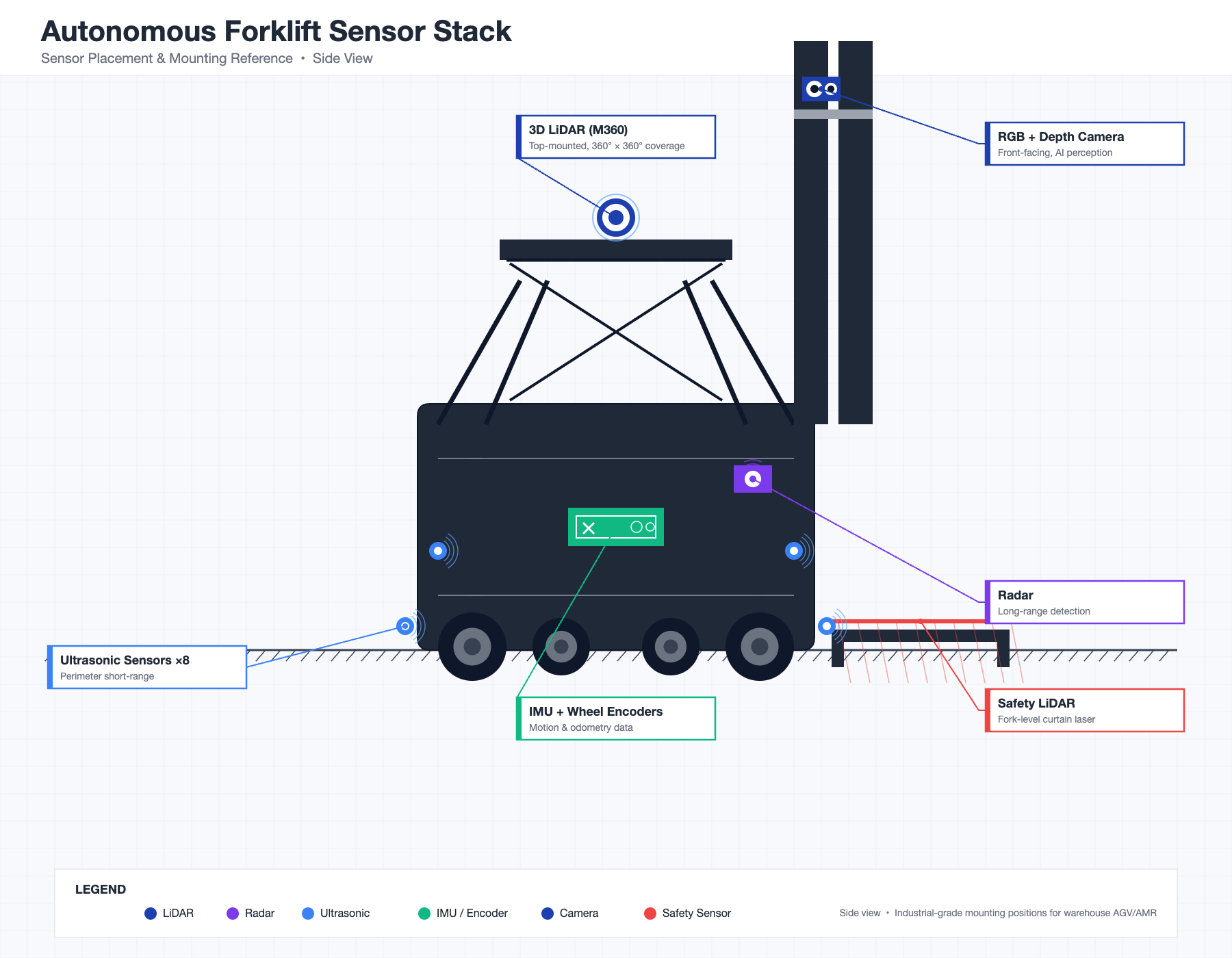
In practice, a properly specced autonomous forklift carries at least 4 ultrasonic sensors (front, rear, and both sides) plus 2 curtain lasers (front and rear bumper level). The ultrasonics handle the "something just appeared in my blind spot" scenario at close range, while the curtain lasers enforce configurable safety zones at slightly longer range.
4. Control and Feedback Sensors
These don't perceive the environment at all—they monitor the forklift's own mechanical state.
- Load Sensors / Fork Strain Gauges — Measure the weight on the forks. Essential for overload protection and for confirming that a pallet pickup was successful (if the weight doesn't change after a fork-in cycle, something went wrong).
- Mast Position Encoders — Track fork height, tilt angle, and reach extension. The automation system needs to know exactly where the forks are to perform automated stacking and retrieval.
- Battery Voltage and Current Sensors — Monitor the power bus for undervoltage (which affects sensor accuracy) and overcurrent (which indicates a motor stall or collision).
These sensors are unglamorous but critical. A forklift that can navigate perfectly but doesn't know its fork height is a forklift that can't automate pallet putaway.
LiDAR: The #1 Sensor for Forklift Navigation
LiDAR is the single most important sensor on an autonomous forklift. It handles localization, mapping, and obstacle detection simultaneously, and it works in complete darkness, under fluorescent warehouse lighting, and through dust. No other sensor technology can make all three claims.
2D LiDAR: The Navigation Workhorse
A 2D LiDAR scanner emits a fan of laser pulses in a single horizontal plane, typically covering 270–360° at 10–30 Hz. It's the standard for SLAM-based navigation on AGV forklifts.
Common installations use a SICK TiM or Hokuyo sensor mounted on a mast-mounted pole, scanning at 1.5–2.5 m above the floor. This height clears ground-level clutter (loose shrink wrap, pallet boards) while staying below overhead obstructions (sprinkler heads, lighting trusses).
The main limitation of 2D LiDAR is exactly that—it's 2D. It cannot detect:
- Fork tip collisions with pallet edges below the scan plane
- Low-hanging obstacles like dock leveler lips or ramp edges
- Pallets stacked at heights above or below the scan plane
- Ground-level pedestrians whose torsos are below the scan height
This is why no serious autonomous forklift relies on 2D LiDAR alone for obstacle detection. It does the heavy lifting for localization, but safety and perception need additional sensors.
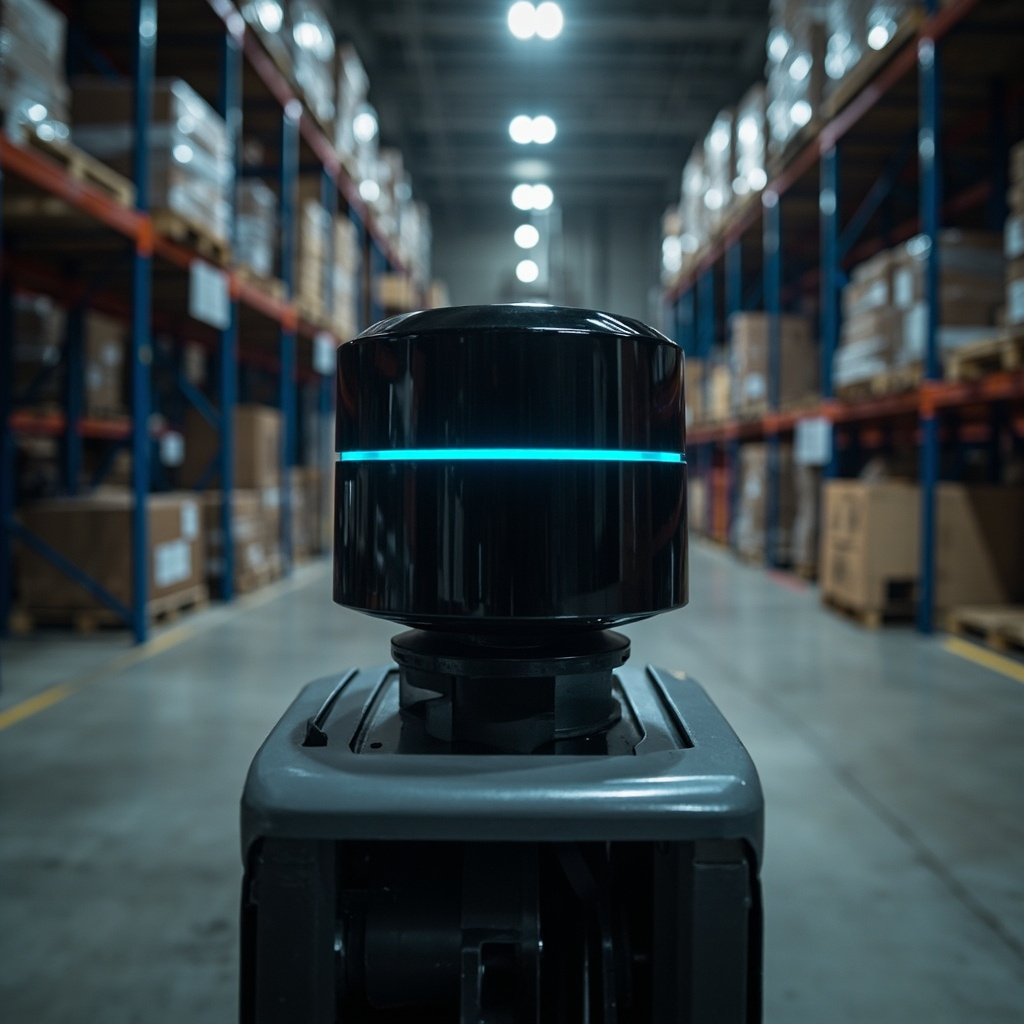
3D LiDAR: When You Need Vertical Awareness
A 3D LiDAR adds vertical scanning channels to the horizontal sweep, producing a true 3D point cloud of the environment. This makes a material difference on a forklift, where the working volume spans from floor level (0 m) to top-of-rack (10–12 m in high-bay warehouses).
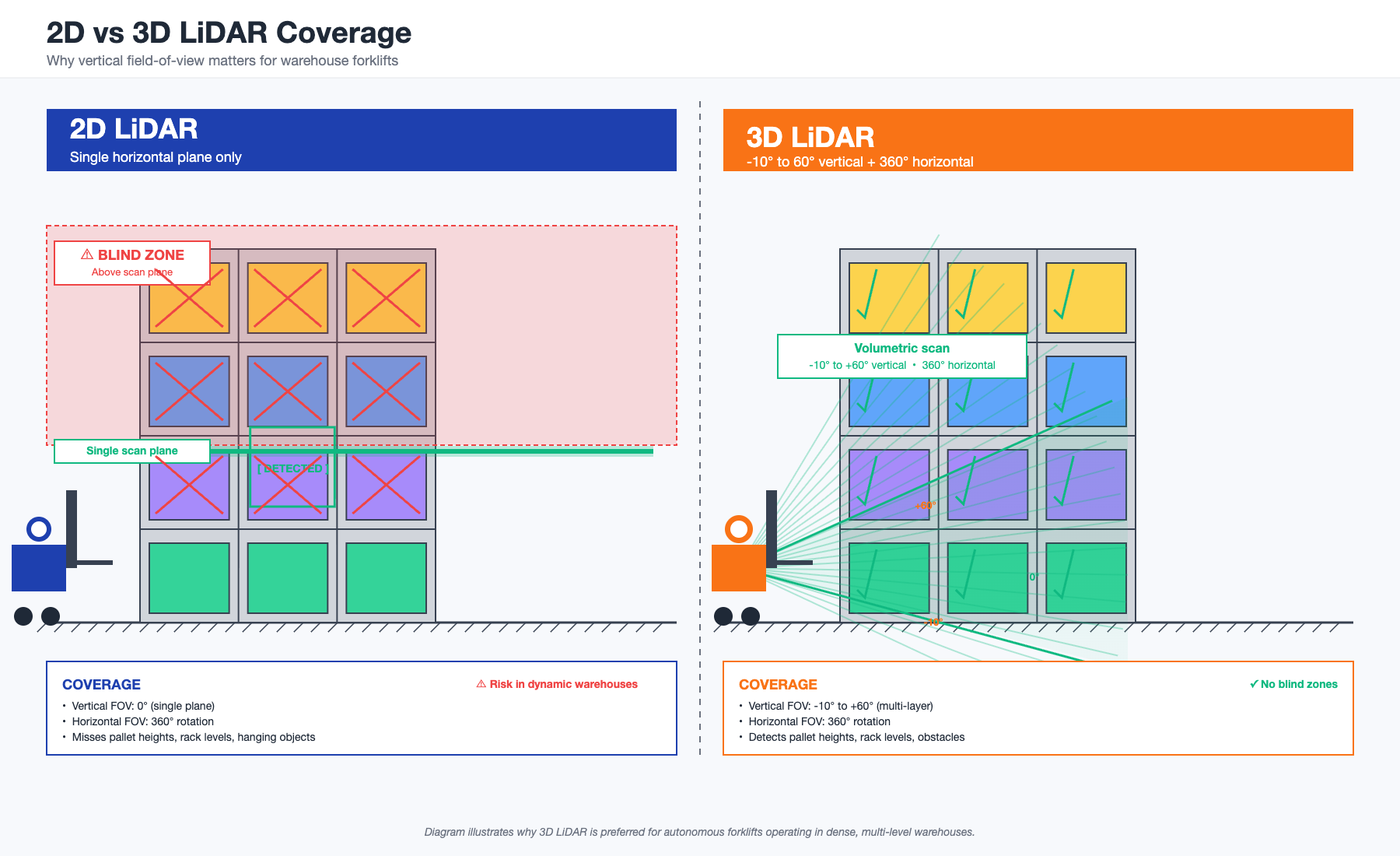
The key spec that matters for forklift applications is vertical FOV. A vertical FOV of 70° (for example, -10° to +60°) means the sensor can see from 10° below horizontal down to 60° above—covering the ground plane, pallet heights, and overhead racking in a single scan. This eliminates the need for separate forward-facing and upward-facing 2D scanners.
Other specs worth watching on a 3D LiDAR for forklift use:
| Spec | Why It Matters for Forklifts | Good Target |
|---|---|---|
| Vertical FOV | Coverage from floor to top-of-rack | ≥70° (-10° to +60°) |
| Range (90% reflectivity) | Detecting racking and walls at distance | ≥50 m |
| Range (10% reflectivity) | Detecting dark pallets, cardboard | ≥25 m |
| Blind zone | Minimum detectable distance—critical for forklift tips | ≤5 cm |
| Ranging accuracy | Pallet alignment tolerance is typically ±2–3 cm | ≤2 cm @10 m |
| Input voltage | Must match forklift battery (24V or 48V systems) | 12–32 V DC |
| IP rating | Warehouses have dust, humidity, occasional washdown | ≥IP67 |
| Power consumption | Sits on the same battery as drive motors | <5 W |
That input voltage range deserves a callout. Most warehouse forklifts run on 24V or 48V battery systems. A LiDAR with a narrow 12V input requires an additional DC-DC converter—extra wiring, extra failure point, extra heat on the mast. Sensors that accept 12–32V DC (or wider) plug directly into the vehicle power bus, which simplifies both the mechanical installation and the electrical design.
Ranging accuracy matters when you consider that pallet pocket alignment tolerance on standard GMA pallets is tight—usually ±2–3 cm. If your 3D LiDAR can resolve distance to within 2 cm at 10 m, it can confirm fork entry depth during pallet pickup with enough margin to catch misalignment before the forks push through the pallet.
2D vs 3D: When to Upgrade
Not every application needs 3D LiDAR. Here's a practical way to think about it:
Stay with 2D LiDAR if:
- Your facility has fixed infrastructure (reflector tape, magnetic tape) that handles localization, and you only need obstacle detection at a single height
- The forklift operates in wide aisles with predictable, floor-level obstacles only
- Budget constraints limit sensor spend to under $1,500 per navigation unit
Move to 3D LiDAR if:
- You're running SLAM navigation in a dynamic environment with frequent layout changes
- The forklift needs to detect obstacles at multiple heights (fork tips, overhead racks, dock plates)
- You want a single sensor to handle both localization and perception, reducing total sensor count and cabling
- The forklift operates in narrow aisles (VNA) where vertical clearance detection prevents rack strikes
For a broader comparison of 3D LiDAR options suitable for AGVs and forklifts, see our AGV LiDAR Comparison Matrix 2026. If you're considering 3D LiDAR for broader robotics applications including handheld scanning, our handheld scanner LiDAR guide covers sensor-level tradeoffs in detail.
Camera vs ToF vs Ultrasonic: Which Goes Where
LiDAR gets most of the attention, but the supporting sensor suite matters just as much. The table below compares the three most common supplementary sensor types used alongside LiDAR on autonomous forklifts.
| Property | 3D Depth Camera | ToF Sensor | Ultrasonic Sensor |
|---|---|---|---|
| Detection range | 0.3–10 m | 0.1–10 m | 0.05–5 m |
| Accuracy | ±1–5 cm | ±1–3 cm | ±3–10 cm |
| FOV | 60–120° (varies) | 20–60° | 15–30° cone |
| Update rate | 30–60 fps | 30–100 fps | 20–40 Hz |
| Lighting dependency | Yes (struggles in direct sun) | Minimal | None |
| Object classification | Yes (with ML) | No | No |
| Cost per unit | $200–$1,500 | $30–$200 | $10–$50 |
| Typical forklift mount | Mast face (pallet detection) | Fork carriage (pallet entry) | Bumper (close-range backup) |
Where Each Sensor Belongs on the Forklift
3D Depth Camera — Mount on the mast face, aimed at pallet pocket height. The camera's ability to classify objects makes it ideal for pallet detection and for distinguishing a usable pallet from a broken one. When paired with a neural network, it can identify pallet orientation, detect missing boards, and verify fork entry into the pocket.
The catch: cameras are the only sensor on this list that cares about lighting. A camera mounted under a dock awning at 2 PM in July will see differently than the same camera at 6 AM in a dimly lit cold-storage area. If your forklift moves between zones with different lighting, you'll need to manage exposure settings or add controlled illumination around the mount point.
ToF Sensor — Mount on the fork carriage, pointing forward. This is the sensor that tells the automation system "the fork tips are 42 cm from the pallet edge" during approach. Because ToF sensors are small (roughly the size of a matchbox) and don't require a separate processor, they're a low-complexity addition to the fork assembly.
ToF sensors work well for short-range distance measurement, but they have a limited effective range (usually under 10 m) and their accuracy degrades on highly reflective surfaces (stainless steel racks, glossy packaging). For most pallet approach applications, this isn't a problem—ToF only needs to be accurate within the last 1–2 m of approach.
Ultrasonic Sensor — Mount at bumper level, front and rear. Ultrasonics are the cheapest way to add a close-range safety layer. They're useful as a backup to curtain lasers in the "something just dropped into my path at 1 meter" scenario. They won't classify the object, but they will trigger a stop.
The main failure mode of ultrasonics on forklifts is false triggering on rough floor surfaces—expansion joints, grate flooring, or the lip of a dock leveler can scatter sound waves in ways that register as obstacles. Tuning the detection threshold and angling the sensor slightly downward (5–10° from horizontal) helps, but expect some false alarms during the first few days of commissioning in any new facility.
Sensor Fusion: Why No Single Sensor Is Enough
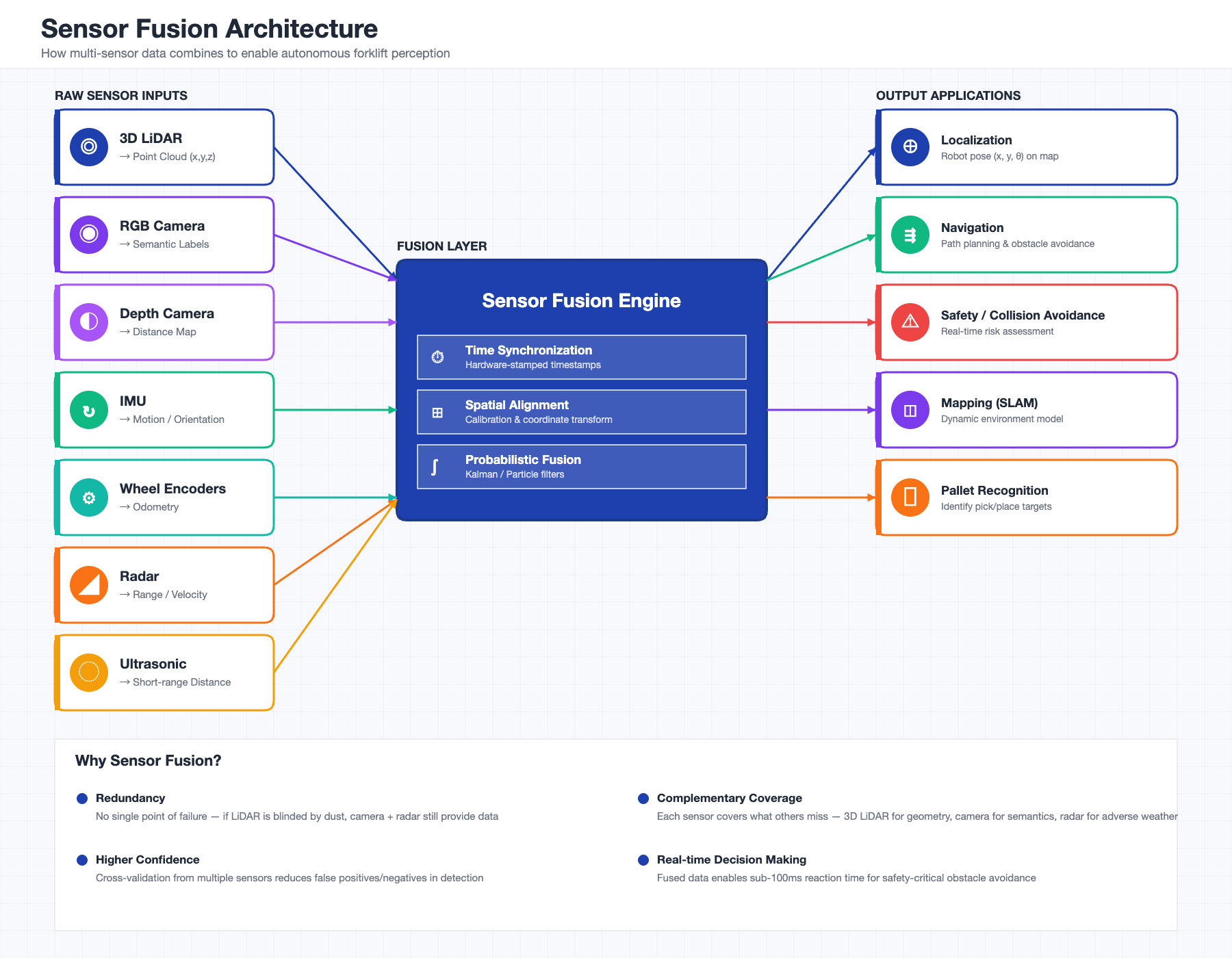
If this article has a central argument, it's this: autonomous forklifts don't run on one sensor. They run on sensor fusion—the process of combining inputs from multiple sensor types into a single, coherent model of the environment.
Here's what that looks like in practice:
Localization: 2D or 3D LiDAR (primary) + IMU (interpolation between scans) + wheel encoders (odometry cross-check) → Extended Kalman Filter → position estimate
Obstacle detection: 3D LiDAR (medium-range, multi-height) + 3D camera (pallet classification at close range) + ultrasonics (close-range backup at ground level) → fused point cloud with semantic labels
Safety stop: Safety-rated curtain LiDAR (configurable fields) + ultrasonic bumpers (hard stop zone) + mechanical bumper (last-resort contact trip) → safety PLC (ISO 13849-1 PLd) → motor cutoff
Each sensor compensates for another sensor's weakness. LiDAR can't read labels—cameras can. Cameras can't range in darkness—LiDAR can. Ultrasonics can't classify objects—LiDAR and cameras can. IMU and encoders fill the gaps during momentary sensor dropouts.
Forklift Sensor Selection Checklist
If you're building or retrofitting an autonomous forklift, here's a condensed forklift sensor selection process:
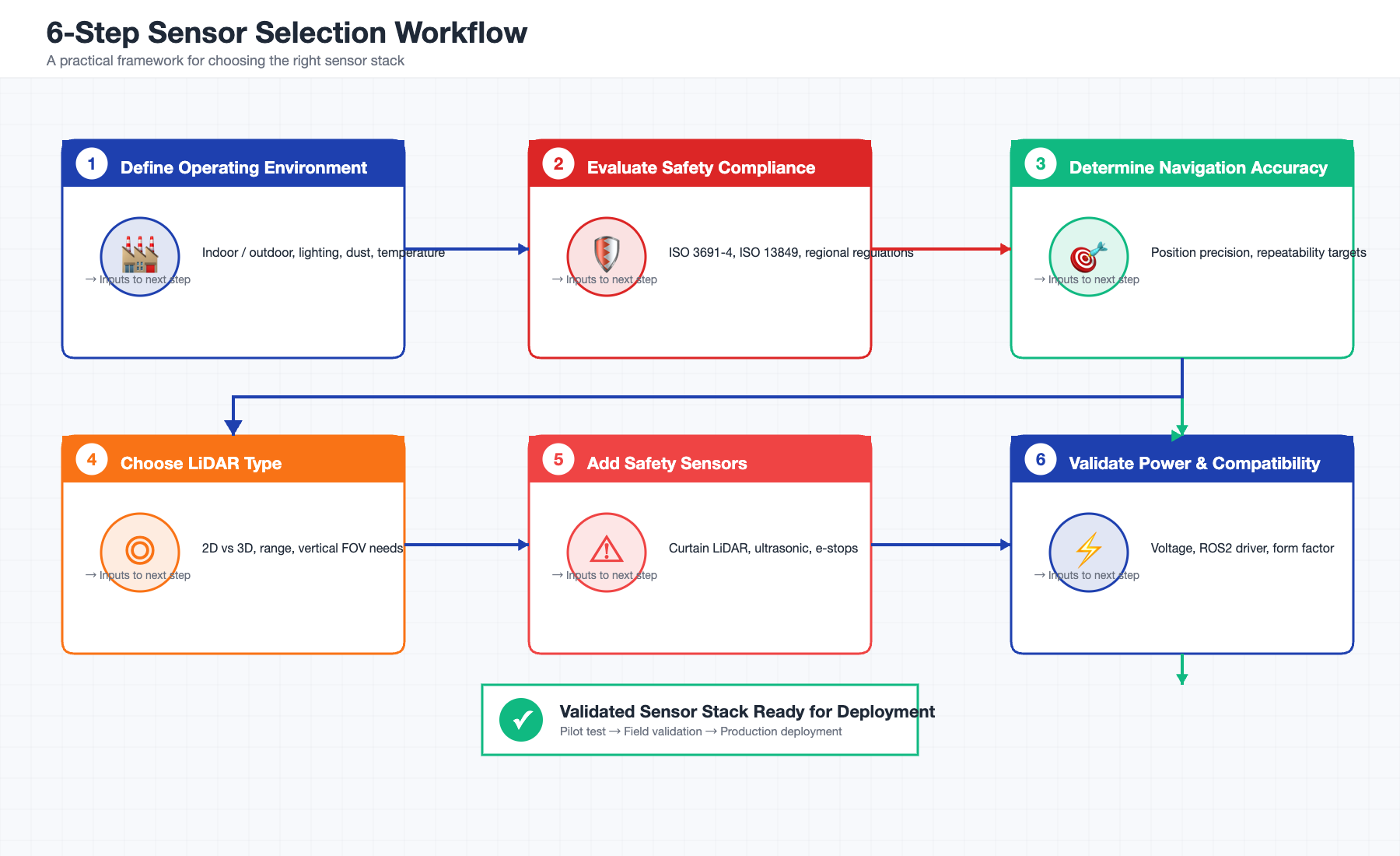
Step 1: Define the operating environment.
- Fixed-path (magnetic tape / reflectors) or free-roaming (SLAM)?
- Indoor only, or does the truck cross dock areas with variable lighting?
- Temperature range, dust levels, floor conditions
Step 2: Determine navigation requirements.
- SLAM → 2D LiDAR minimum, 3D preferred if obstacle detection at multiple heights is needed
- Reflector-based → 2D LiDAR (reflective tape detection) + IMU + encoders
- GNSS-assisted (outdoor yards) → RTK-GNSS receiver + IMU + 2D LiDAR
Step 3: Specify perception needs.
- Pallet detection and classification → 3D depth camera on mast face
- Pallet entry distance → ToF sensor on fork carriage
- Multi-height obstacle detection → 3D LiDAR (replaces multiple 2D scanners)
Step 4: Layer in safety sensors.
- Minimum: 2 safety-rated curtain lasers (front + rear) + 4 ultrasonic bumpers
- For mixed human/robot zones: add zone-based speed reduction tied to LiDAR safety fields
- Verify safety PLC rating meets ISO 13849-1 PLd or equivalent
Step 5: Confirm mechanical and electrical compatibility.
- Sensor input voltage matches vehicle power bus (12V, 24V, or 48V)?
- Mounting points on mast, counterweight, and forks are accessible?
- Cable routing doesn't interfere with mast tilt or fork movement?
- Total sensor power draw within battery budget?
Step 6: Plan for commissioning and tuning.
- Safety field tuning (warning zone radius, stop zone radius) per aisle and zone
- Pallet detection model training if using cameras with ML
- False-alarm rate acceptance criteria (target: <1 false stop per hour per sensor)
Frequently Asked Questions
How many sensors does an autonomous forklift typically carry?
A production-ready autonomous forklift usually carries 8–15 sensors: 1–2 LiDAR units (navigation + perception), 1–2 depth cameras, 1 IMU, 2–4 ultrasonic sensors, 2 safety-rated curtain lasers, 1–2 ToF sensors, wheel encoders, and load/height feedback sensors. The exact count depends on the automation level and safety requirements of the operating environment.
Can an autonomous forklift run on cameras alone, without LiDAR?
Some systems use vision-only navigation (Seegrid and Veeva are examples), but cameras alone struggle in low-light conditions, with reflective surfaces, and in environments where visual features are sparse (long white-walled corridors, identical rack faces). For most warehouse applications, LiDAR provides a more reliable localization backbone. Camera-only systems work best in facilities with consistent lighting, rich visual features, and limited outdoor exposure.
Is 3D LiDAR worth the cost over 2D for warehouse forklifts?
If the forklift operates in standard wide aisles with floor-level obstacles only, a 2D LiDAR plus ultrasonics can handle perception adequately. But in narrow aisles, multi-level racking, or any environment where the forklift needs vertical awareness (detecting overhead obstructions, fork-tip clearance, pallet overhang), 3D LiDAR replaces the need for multiple 2D scanners at different heights and simplifies both the sensor suite and the wiring harness. For new builds and major retrofits, the installation savings often offset the higher unit cost.
What's the typical sensor failure mode, and how do autonomous forklifts handle it?
The most common failures are cable disconnection (vibration on mast-mounted sensors), lens contamination (dust, oil, warehouse grime), and software timeouts (sensor firmware crashes). Redundant sensor coverage means a single failure doesn't stop the truck—a failed camera doesn't prevent LiDAR-based navigation, and a failed ultrasonic doesn't prevent LiDAR-based obstacle detection. Safety-rated sensors (curtain lasers) connect directly to the safety PLC on a separate circuit, so even a main computer crash won't disable the safety stop function.
How often do forklift sensors need calibration or maintenance?
LiDAR sensors are generally calibration-free after initial mounting. Depth cameras may need exposure re-tuning when ambient lighting changes significantly (seasonal shifts, new lighting installations). Ultrasonics require periodic cleaning of the transducer face to prevent false readings. Safety-rated curtain lasers have a specified validation interval (typically 6–12 months) that must be documented per ISO 13849 requirements. Mechanical bumpers and contact strips should be visually inspected during routine forklift maintenance cycles.