TL;DR: When selecting AGV LiDAR, engineers typically prioritize range, accuracy, and point cloud density. But one parameter is severely underestimated — near-blind zone (near-blind zone / minimum detection range). It directly determines your AGV's collision rate in dense warehousing and human-robot coexistence scenarios. This article compares near-blind zone parameters of 6 mainstream 3D/2D LiDAR sensors, from nominal specs to reliable detection values, combined with braking distance analysis and scenario-based requirements grading.
1. Why "Near-Blind Zone" Is the Most Underrated AGV LiDAR Parameter
Consider a real scenario. A third-party logistics warehouse with 30潜伏式 AGVs (under-rider AGVs) carrying pallets through narrow aisles. Each AGV is equipped with a mainstream 3D LiDAR: 50m range, 2cm accuracy — the spec sheet looks perfect. But after three months of operation, collision reports tripled — not from distant objects, but from close-range incidents: grazing shelf legs, running over floor cables, scraping low-profile turnover boxes.
The problem? Near-blind zone.
Near-blind zone (also called minimum detection range) is the shortest distance at which a LiDAR can reliably detect obstacles. Within this zone, the sensor either produces no return signal or returns point cloud so sparse that algorithms cannot effectively identify obstacles.
Most engineers doing LiDAR selection focus on range (50m vs 100m), accuracy (±2cm vs ±3cm), and power consumption (5W vs 10W). Near-blind zone? They glance at the datasheet, see "0.1m" or "0.05m," think "close enough, braking will handle it" — then discover in actual deployment that the gap between that number and real performance is enough to crash an entire AGV into a shelf.
This isn't an isolated case. In dense warehousing, shelf leg diameter may be only 5–8cm; floor cables, low barriers, and pallet bottom crossbeams are typically 10–20cm tall. If your LiDAR's near-blind zone is 10cm or 20cm, at 1m/s approach speed, the sensor may detect the obstacle less than 0.1 seconds before impact — accounting for braking delay and system response time, collision becomes almost inevitable.
The near-blind zone is one of the most underestimated yet impactful parameters in AGV LiDAR selection.
2. What Is Near-Blind Zone? The Gap Between Nominal and Reliable Detection
2.1 Technical Definition
Near-blind zone (minimum detection range) is the shortest distance at which a LiDAR can produce valid ranging signals. Below this distance, the laser pulse's return signal is too strong (saturation) or the reflection path is abnormal, preventing the ranging module from correctly calculating distance.
For different LiDAR types, the causes vary:
- Mechanical LiDAR (e.g., Hesai XT32): Laser and detector are separately mounted; near-distance targets cause angular deviation in return beams, exceeding the detector's reception window.
- Solid-state LiDAR (e.g., Livox MID-360, M360): APD array saturates at close range, requiring algorithmic compensation to recover usable point cloud.
- 2D LiDAR (e.g., Hokuyo UST-10LX, SICK LMS511): Single-line scanning structure determines minimum resolvable distance.
2.2 Nominal Value ≠ Reliable Detection Value: This Is the Key Point
The core argument of this article: The "minimum detection distance" on a LiDAR datasheet is a nominal value. There is a significant gap between it and the "reliable detection distance" in actual deployment.
Nominal value: Measured by the manufacturer under ideal conditions (high-reflectivity standard target, optimal temperature, static test) — the distance at which "at least one return signal" is received.
Reliable detection distance: In your actual deployment scenario (complex reflectivity, dynamic targets, vibration), the distance at which the LiDAR outputs sufficient point cloud density for your obstacle avoidance algorithm to reliably identify obstacles.
The gap can be substantial:
- Nominal 5cm → may need 10cm to get 3–5 usable points, where clustering algorithms barely work
- Nominal 10cm → may need 15–20cm for stable frame output
- Nominal 20cm → essentially "sees but can't see clearly," algorithms prone to missed detections
Causes of the gap include:
- Reflectivity differences: Nominal values are based on 90% reflectivity white standard targets. Black shelves, transparent film, and metal reflective surfaces in warehouses significantly increase actual minimum detection distance.
- Point cloud density decay: Near the blind zone boundary, effective point count drops sharply — from hundreds of points/frame to just a few. Algorithm reliability collapses accordingly.
- Motion blur: When the AGV is moving, relative motion of near-distance targets causes point cloud distortion, further reducing detection reliability.
- Ambient light interference: Warehouse fluorescent lights, direct window light, and other strong light sources interfere with close-range return signals.
Recommendation: When selecting LiDAR, don't just look at the minimum detection distance on the datasheet. Request the manufacturer's minimum detection distance at 10% reflectivity, or test point cloud density at 5cm/10cm/15cm with a standard target yourself. That's the reliable basis for selection.
2.3 Engineering Measurement Method
If you have evaluation units, follow these steps for quick verification:
- Prepare standard targets: A 10cm×10cm Kodak gray card (18% reflectivity gray side) and a white diffuse reflector (90% reflectivity)
- Set distances: Place targets at 5cm, 8cm, 10cm, 15cm, and 20cm
- Collect point cloud: Capture 100 frames per distance (~1 second), count valid points and distance standard deviation
- Analyze density: Calculate average points/frame at each distance, plot point cloud density vs. distance curve
- Determine reliable detection distance: Find the inflection point where density drops sharply — this is your "reliable detection distance"
3. Near-Blind Zone Comparison: 6 Mainstream LiDAR Sensors
3.1 Core Comparison Table
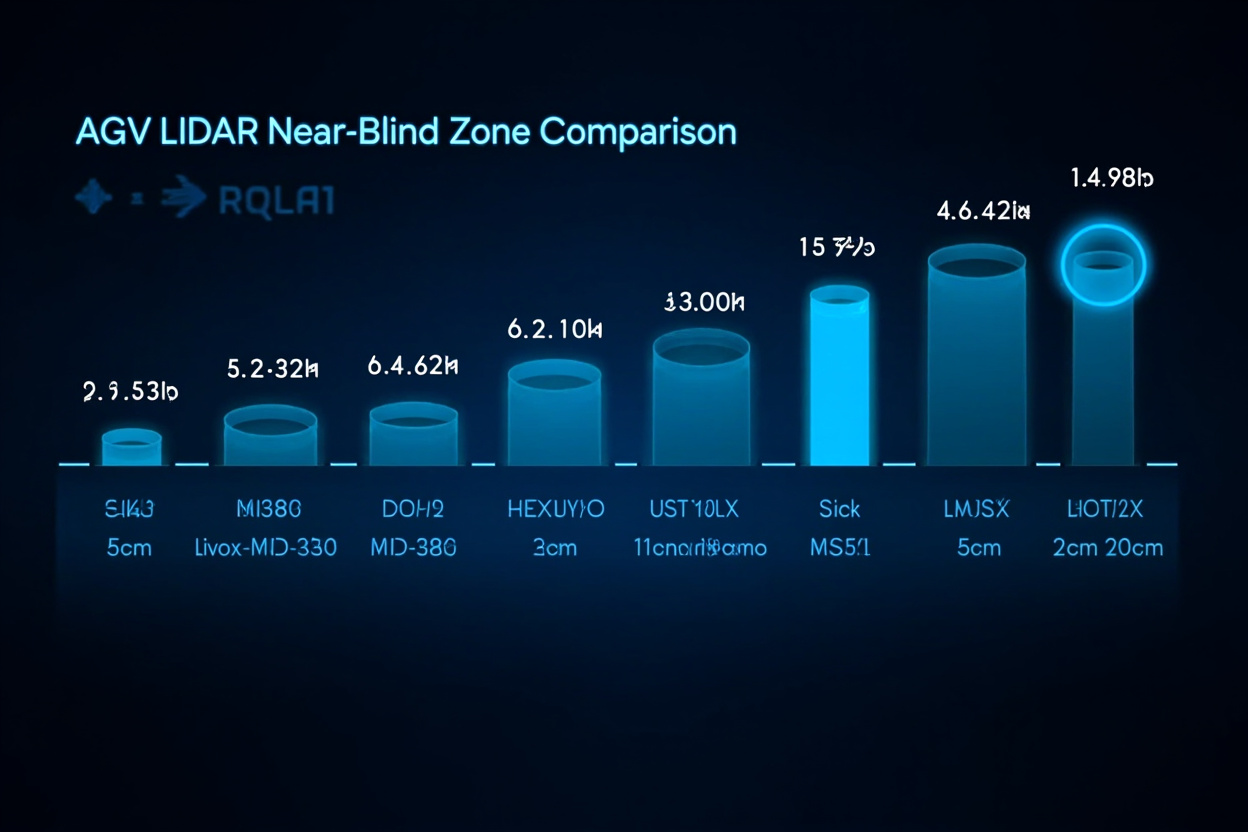
| # | Product | Type | Nominal Blind Zone | Reliable Detection* | FOV (H×V) | Price | Range (90% ref.) |
|---|---|---|---|---|---|---|---|
| 1 | M360 | 3D Solid-state | 5cm | 5cm (high density) | 360° × 70° | Inquiry | 0.05–50m |
| 2 | Livox MID-360 | 3D Solid-state | 10cm | ~15cm (density drops) | 360° × 59° | ~$899 | 0.1–40m |
| 3 | Hesai XT32 | 3D Mechanical | 5cm | ~10cm (edge sparse) | 360° × 31° | ~$3,833 | 0.05–120m |
| 4 | Hokuyo UST-10LX | 2D | 6cm | 6cm (2D single-line stable) | 270° | ~$1,200 | 0.06–10m |
| 5 | SICK LMS511 | 2D | ~20cm | ~20cm (industrial legacy) | 190° | ~$2,500 | 0.2–80m |
| 6 | Livox Mid-70 | 3D Solid-state | 5cm | 5cm (high density) | 70.4° × 70.4° | $1,099 | 0.05–25m |
* Reliable detection values are engineering estimates based on manufacturers' public data, technical documentation, and typical operating conditions. We recommend field testing with standard targets before formal deployment.
3.2 Individual Sensor Analysis
M360 (SmartBotParts)
Nominal 5cm blind zone, reliable detection also at 5cm. This is the only 3D LiDAR in this comparison where nominal and reliable detection values match exactly.
M360 uses a 360° non-repetitive scanning structure (dual rotating prisms), different from Livox's petal-pattern and Hesai's mechanical rotation. Longer integration time yields higher angular coverage and denser point cloud — at 2.5s integration, horizontal angular resolution reaches 0.18°.
Key specs: 905nm wavelength, Class 1 safety; built-in 3-axis accelerometer + 3-axis gyroscope (IMU); IP67 protection, industrial temperature range (-10°C to +60°C); power consumption <4.5W; ROS2 driver open-source at github.com/BlueSeaLidar/m-series.
Best for: Dense warehousing, narrow aisles, human-robot coexistence — any scenario requiring 360° comprehensive near-field perception. The 360° × 70° FOV means it works as a standalone primary sensor without supplementary blind-spot fillers.
Livox MID-360
Livox's star product with massive ROS community adoption. Nominal 10cm blind zone is middle-of-the-pack for 3D solid-state LiDAR. However, point cloud density drops noticeably around 10cm. The petal-pattern scanning covers well over time, but single-frame (10Hz) near-field coverage is uneven. For AGV obstacle avoidance requiring fast response, this means only scattered points in the 10–15cm range.
Best for: Teams prioritizing ROS ecosystem maturity. If you need strict near-blind zone requirements, verify near-field point cloud density meets your algorithm's needs.
Hesai XT32
High-performance 3D mechanical LiDAR with nominal 5cm blind zone — looks as good as M360 on paper. But mechanical LiDAR has a unique characteristic: point cloud density at scan-line edges (vertical FOV boundaries) is inherently lower than the center. At 5cm, center scan lines may have valid returns, but edge lines may need 10cm+ for usable points.
At ~$3,833, XT32 costs roughly 10x the M360. If your primary need is indoor AGV near-field avoidance rather than long-range sensing, the cost efficiency needs careful consideration.
Hokuyo UST-10LX
Hokuyo's classic 2D LiDAR, nominal 6cm blind zone — decent for 2D. But 2D LiDAR's fundamental limitation is a single scanning plane — it can only detect obstacles at exactly one height. Floor cables, low barriers, and pallet crossbeams are completely invisible. Even at 6cm blind zone, it only works for obstacles at the scanning plane height.
Best for: Supplementary sensor (e.g., side-mount for same-height obstacle detection). Not recommended as primary sensor.
SICK LMS511
An industrial automation classic, but the largest blind zone in this comparison: nominal ~20cm, 2D only. 20cm blind zone at 1m/s AGV speed means only ~0.15 seconds for system response and processing after detection — extremely tight for safety-critical applications. The 190° FOV (not 360°!) leaves 170° of complete blind area behind the sensor.
Best for: Fixed industrial applications (conveyor detection, area security). Not recommended for mobile AGVs.
Livox Mid-70
Same 5cm nominal blind zone with excellent near-field density. But FOV is only 70.4° × 70.4° — less than 1/10th of M360's coverage. Covers only ~1/5 of the AGV's frontal area. An excellent blind-spot filler for specific directions (front, side), but not a standalone primary sensor.
Best for: Supplementary near-field sensor when paired with a wide-FOV primary LiDAR. Outstanding cost-performance for targeted blind-spot filling.
3.3 Summary Matrix
| Dimension | Best Choice | Notes |
|---|---|---|
| Smallest blind zone | M360, Hesai XT32, Mid-70 (nominal 5cm) | XT32 has larger reliable detection value |
| Smallest reliable detection | M360, Mid-70 (actual 5cm) | Only two with matching nominal and tested values |
| Largest FOV | M360 (360° × 70°) | Far exceeds all others |
| Best value | M360 | 5cm blind zone + 360° FOV + IP67 |
| Ecosystem maturity | Livox MID-360 | Largest ROS community install base |
4. How Near-Blind Zone Affects AGV Safety — A Simple Math Model
4.1 Braking Distance Formula
Whether an AGV can stop safely after detecting an obstacle depends on:
Safe stopping distance = System response distance + Braking distance + Safety margin
Where:
- System response distance = AGV speed × system response time (typically 0.1–0.3s, including sensor sampling delay, algorithm processing, and actuator response)
- Braking distance = v² / (2a) (v = speed, a = deceleration; typical AGV: 0.2–0.5g)
- Safety margin = typically 5–10cm
4.2 Safety Margin Analysis at Different Blind Zones
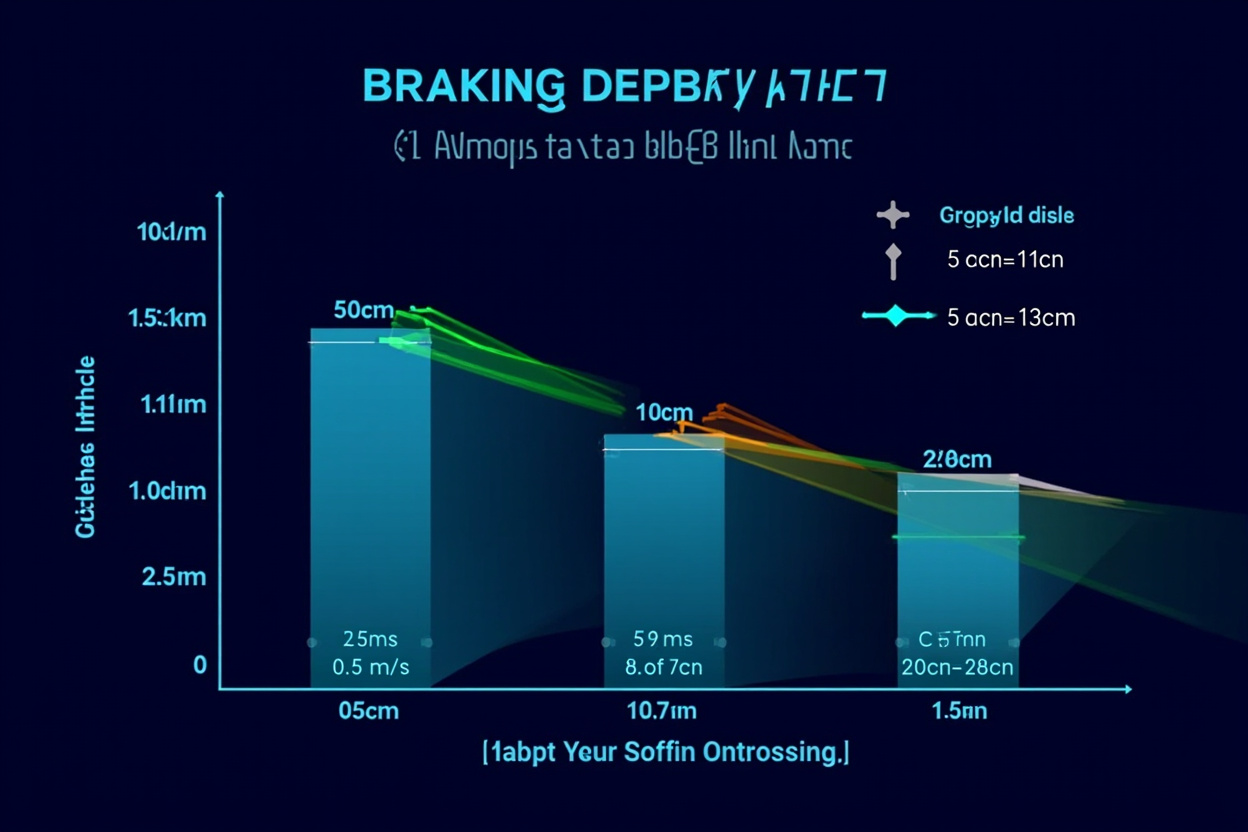
Assuming 0.2s system response time, 0.3g braking deceleration (2.94 m/s²), 5cm safety margin:
| AGV Speed | Response Dist. | Braking Dist. | Min Stop Dist. | 5cm Margin | 10cm Margin | 20cm Margin |
|---|---|---|---|---|---|---|
| 0.3 m/s | 6cm | 1.5cm | 12.5cm | ✅ 7.5cm | ✅ 2.5cm | ⚠️ Insufficient |
| 0.5 m/s | 10cm | 4.2cm | 19.2cm | ✅ 14.2cm | ✅ 9.2cm | ⚠️ Marginal |
| 1.0 m/s | 20cm | 17cm | 42cm | ✅ 37cm | ✅ 32cm | ✅ 22cm |
| 1.5 m/s | 30cm | 38cm | 73cm | ✅ 68cm | ✅ 63cm | ✅ 53cm |
Margin = Min stop distance – blind zone distance. Negative or near-zero values mean safe stopping is not possible within the blind zone distance.
Key findings:
- Low-speed scenarios (≤0.5m/s): 20cm blind zone already fails safe stopping at 0.3m/s; 10cm is barely adequate. Only 5cm provides sufficient margin.
- Mid-speed (1.0m/s): Braking distance dominates; blind zone impact is relatively reduced. But 20cm still provides 15cm less early warning than 5cm.
- High-speed (1.5m/s): Safe stopping distance far exceeds blind zone; but system response distance is already 1.5–6x the blind zone distance.
Conclusion: Near-blind zone impact on AGV safety is most significant in low-speed, close-range operations — the typical working condition for warehouse AGVs.
4.3 ISO 3691-4 Safety Standard
ISO 3691-4:2020 requires AGVs/AMRs to have "adequate safe stopping capability." While it doesn't directly mandate "LiDAR blind zone must be ≤X cm," our math model shows:
- For low-speed warehouse AGVs (0.3–0.5m/s), blind zone should be ≤5–10cm to meet safe stopping requirements
- For human-robot coexistence (requiring shorter safety distances), ≤5cm is recommended
- ISO 3691-4 also requires redundant safety design — even with 5cm blind zone LiDAR, supplementary ultrasonic or 3D ToF sensors are recommended as near-field redundancy
5. Scenario-Based Blind Zone Requirements
Level 1: Light-Duty Transport (≤20cm acceptable)
Typical scenario: Large logistics center point-to-point transport, open aisles, standard shelf spacing, few obstacles.
Recommended: SICK LMS511 (budget), Hokuyo UST-10LX (2D sufficient)
Level 2: Heavy-Duty Forklift (≤10cm)
Typical scenario: Pallet stacking, high-shelf operations, forklifts navigating between narrow shelves, precision requirements high.
Recommended: Livox MID-360, Hokuyo UST-10LX (2D supplementary)
Level 3: Dense Warehousing Narrow Aisles (≤5cm)
Typical scenario: E-commerce sorting centers, 3PL warehouses, aisles only 1.5–2m wide, high AGV density, shelf legs/turnover boxes/cables everywhere.
Recommended: M360 (first choice), Livox Mid-70 (supplementary blind-spot filler)
In 1.5m-wide aisles, AGV-to-shelf clearance may be only 20–30cm. At 10cm or 20cm blind zone, system response and braking time is almost zero. M360's 5cm + 360° × 70° FOV provides the ideal configuration.
Level 4: Human-Robot Coexistence (≤5cm + redundant sensors)
Typical scenario: Factory floors, hospital logistics, retail warehousing with frequent human traffic.
Recommended: M360 (primary) + 3D ToF / ultrasonic (redundant near-field)
ISO 3691-4 explicitly requires redundant safety design. M360's IP67 protection and built-in IMU also provide advantages — industrial dust/moisture won't affect performance, and built-in IMU supplies additional pose data for safety algorithms.
6. Beyond Blind Zone: Other Selection Criteria
Blind zone is critical, but it's not the only factor. For a holistic evaluation, use our AGV LiDAR evaluation framework (15-point checklist) which weights blind zone alongside FOV, IP rating, power consumption, dual echo, and more.
| Dimension | Why It Matters | M360 Performance |
|---|---|---|
| FOV | Determines single-sensor coverage, affecting sensor count and cost | 360° × 70°, industry-leading |
| Point Cloud Density | Affects detection accuracy and long-range capability | 200kHz, extremely high density |
| Power | Battery-powered AGVs need low-power sensors for longer runtime | <4.5W, industry-low |
| IP Rating | Industrial environments need IP65+ | IP67, dust/water proof |
| Interface | Compatibility with existing systems; ROS2 support is a plus | Ethernet UDP + open-source ROS2 driver |
| Accuracy | Affects navigation and avoidance precision | ≤2cm @10m, above industry average |
| Size/Weight | Small AGVs are sensitive to sensor size/weight | 78×78×81mm, 408g, very compact |
See full parameter comparison for detailed specs across all dimensions.
7. Selection Decision Tree: How Small Should Your AGV's Blind Zone Be?
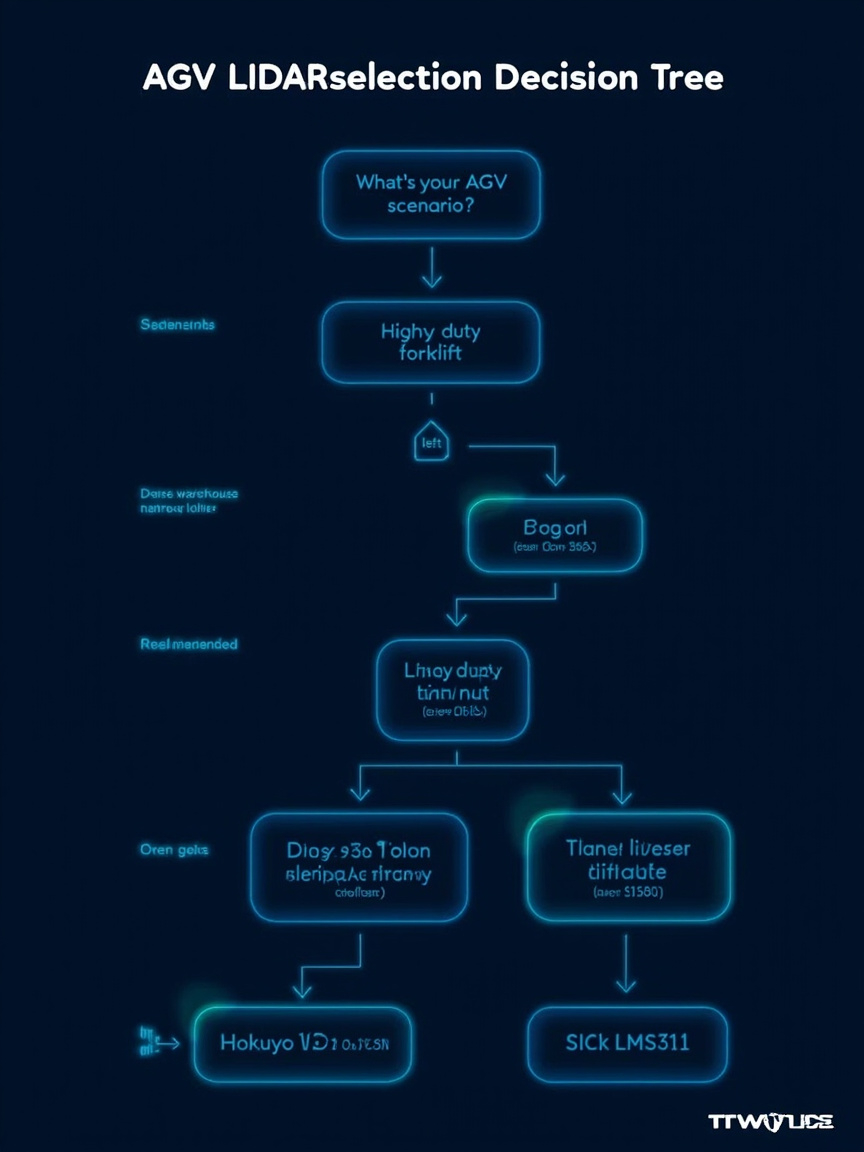
Use this decision flow to quickly identify the right product:
Core conclusion:
- Most indoor AGV scenarios (dense warehousing, narrow aisles, human-robot coexistence) require ≤5cm blind zone
- A 3D LiDAR with ≤5cm and 360° FOV — M360 is the most comprehensive choice
- Budget-constrained? MID-360 is a compromise, but accept 10cm blind zone and near-field density trade-offs
- Single-plane avoidance only? UST-10LX offers better value
8. Conclusion: Don't Judge a LiDAR by One Number
Back to the title question: Is 5cm enough for AGV LiDAR blind zone?
The answer depends on your scenario: for open-aisle light-duty transport, even 20cm might suffice. But for dense warehousing, narrow aisles, and human-robot coexistence, 5cm isn't about "enough or not" — it's the minimum mandatory standard.
More importantly: don't be fooled by datasheet nominal values. Nominal 5cm doesn't equal reliable 5cm. Different manufacturers use different measurement methods, reflectivity baselines, and point cloud density standards, so two products both labeled "5cm" can have 2–3x difference in actual near-field performance.
The right way to select LiDAR:
- Define your scenario needs first: speed, obstacle types, safety standards, budget
- Then select products matching your parameter tier: not the "best," but the "most suitable"
- Finally, verify with testing: use standard targets in your actual environment to confirm reliable detection distance
See also: AGV/AMR LiDAR Selection Guide (2026) for comprehensive selection criteria.
© 2026 SmartBotParts. All rights reserved.
"Reliable detection values" in this article are engineering estimates based on publicly available technical documentation. Actual performance varies with environmental conditions, installation method, and target reflectivity. We recommend field testing before formal deployment. All product names are trademarks of their respective manufacturers.